
Sovereignty Doesn’t End at Self-Custody
In this article:
Most Bitcoiners like to think they’re already ahead of the game.
They hold their own keys, avoid custodians, and pat themselves on the back for understanding the risks of fiat. From where they sit, the hard part is over. They’ve done the work. They’re sovereign now.
But that warm, smug confidence rests on a quiet and dangerous assumption: that the system they opted out of has simply stayed the same, frozen in time, politely waiting while everyone walked, or ran, toward the exit door. If only things were so simple…

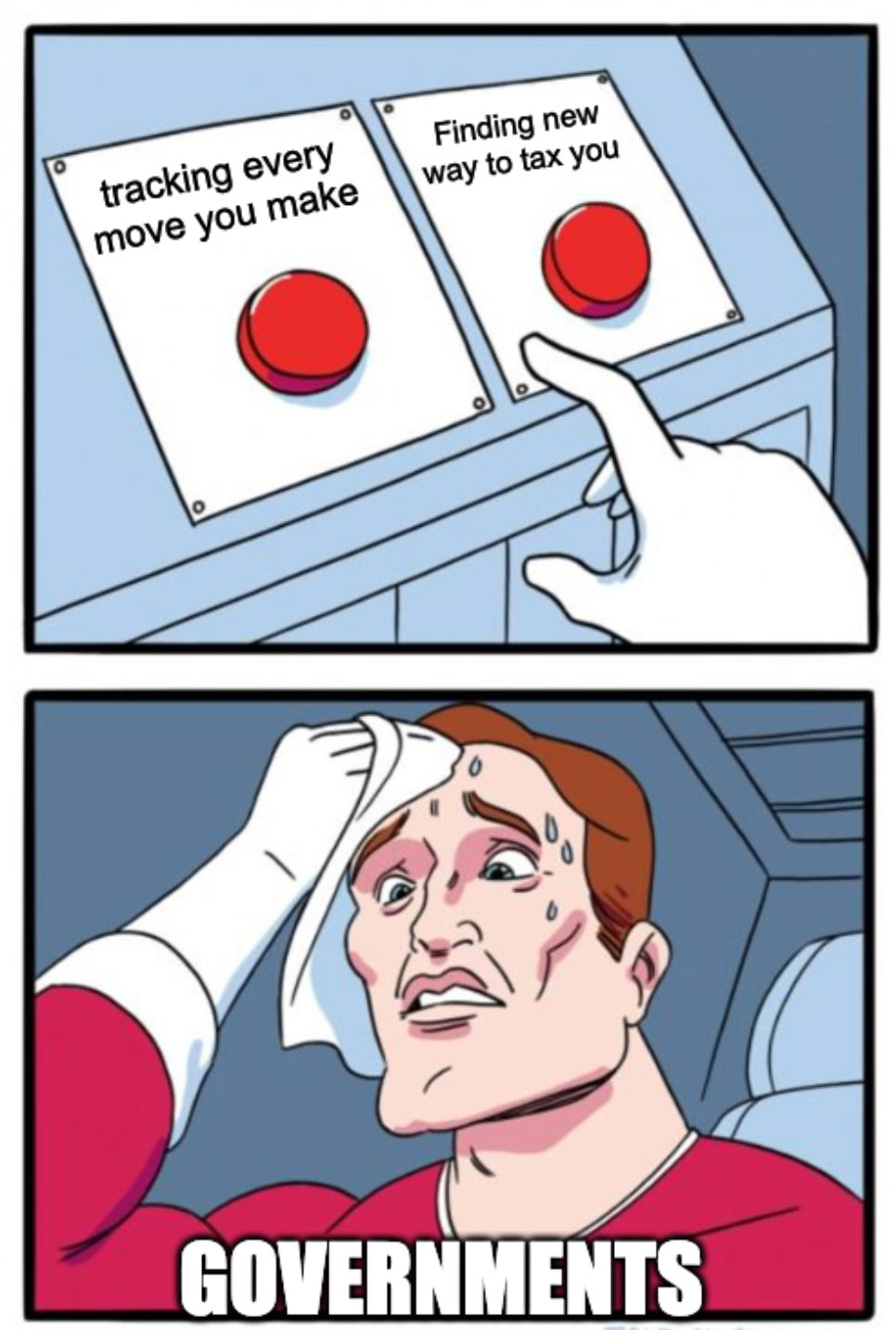
While you have been quietly learning how to secure your sats, your government has been getting better at exactly two things: tracking your every move, and finding new ways to tax you. Not with loud declarations or dramatic crackdowns, but with a steady, methodical commitment to stealing your wealth.
If you still think your financial life is largely private or that holding Bitcoin is enough to protect you from your government, it’s worth asking what that belief is based on.
There haven’t been any dramatic rule changes that have made global headlines, but there are a few pieces of legislation emerging from specific countries that should give all Bitcoiners pause for thought. Two clear examples stand out: In the Netherlands, the clowns in charge want to move toward taxing unrealized gains. While Australia already applies similar logic on exit, treating your assets as sold when you leave.
If you don’t live in these countries, it is easy to assume none of this applies to you. But the direction of travel is unmistakable.
If you are holding KYC Bitcoin in self-custody, you should assume that at some point the state will try to assert a claim over it. Whether you comply or not is your decision, but it would be a mistake to underestimate how far they are willing to go.
They Already Have the Data
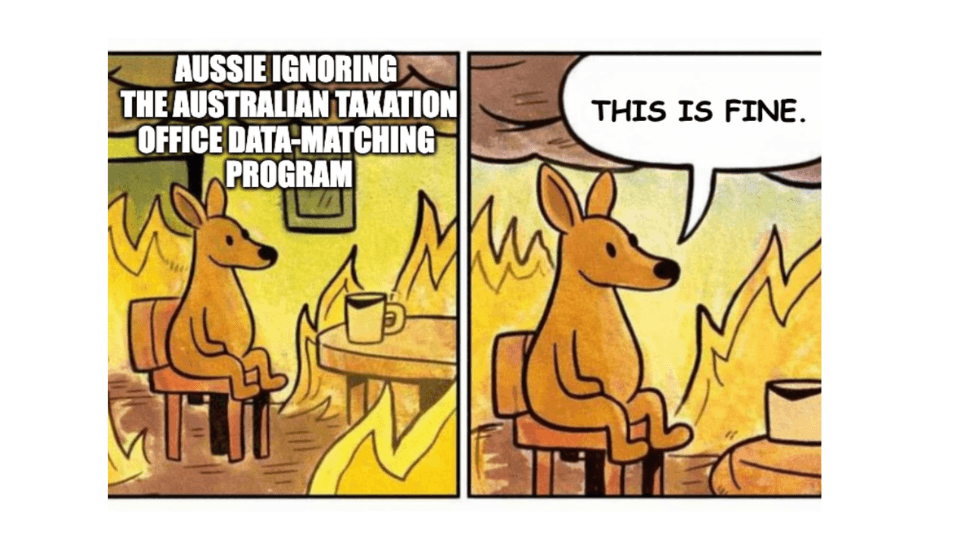
As mentioned above, Australia is one of the best examples of where this is going. The Australian Taxation Office (ATO) isn’t relying on rough estimates, anonymous blockchain analysis, or vague suspicions about “people doing Bitcoin stuff online”.
It has a formal crypto-assets data-matching program under which it acquires account identification and transaction data from designated service providers for the 2023–24 through 2025–26 financial years. Never forget that your exchange will always comply with the state.
The ATO openly states the program is there to identify taxpayers who may not be complying with their obligations. In plain English, they take every trade, every deposit, every withdrawal from the exchanges and line it up next to what you actually reported on your tax return. Then they check whether the numbers match.

Then there’s Europe, where the similar methods have been dressed up in a more elegant bureaucratic wrapper.
Under DAC8, the shiny new Council Directive 2023/2226, EU member states will require exchanges to collect detailed data on all reportable transactions involving EU-resident users starting 1 January 2026. That information gets automatically exchanged every year with the user’s country of residence.

The European Commission is unusually honest about the goal: Bitcoin moves across borders and is hard to track with their old tools, so they need “stronger administrative cooperation” to make sure tax authorities can properly assess and collect income and capital gains taxes. That’s not a side note buried in the fine print. That is the stated policy objective, said out loud.
And DAC8 isn’t some uniquely European flourish. It is explicitly built on the OECD’s Crypto-Asset Reporting Framework, better known as CARF. The OECD, the Organization for Economic Co-operation and Development, is the same club that sets many of the global rules for automatic tax information sharing between countries. CARF simply takes that old system and extends it straight into Bitcoin. Bear in mind this isn’t confined to Europe. It is part of a broader shift toward global reporting, and it would be a mistake to assume it won’t reach you simply because you live elsewhere.

In practice, exchanges and service providers are now required to collect detailed user data and hand it over so it can be automatically shared across borders. As of early 2026, dozens of jurisdictions had already signed the multilateral agreement, including Belgium, the Netherlands, Norway, Spain, Switzerland, and many others quietly falling into line.
You Can’t Just Walk Away
In Australia, the moment you stop being an Australian resident for tax purposes, the ATO generally treats it as if you’ve sold all your assets at their current market value. You might get a deferral option on some assets, but the core reality doesn’t change: simply changing where you live can trigger a tax bill without you ever actually selling.
Norway is even less shy about it. In its 2025 budget changes, the government openly tightened exit-tax rules, framing it as “closing loopholes”. The official line is crystal clear: any unrealized gains you built up while living in Norway will be taxed in Norway when you leave.
They calculate it at fair market value and let you defer the pain for up to 12 years, but the liability doesn’t magically disappear just because you moved.

Different countries, different tools. But the pattern is identical everywhere.
When states are overextended, indebted, and structurally addicted to revenue, they don’t suddenly discover restraint. They build better surveillance and introduce new creative ways to steal your money and time. They turn your decision to move into a taxable event and treat anything they can’t track as a technical problem that needs to be fixed.
This doesn’t mean mobility is gone. It means the margin for error is.

You can still move, restructure, and more importantly reduce your exposure. But the days of simply “leaving and figuring it out later” are over. You need a comprehensive and well structured plan.
Waiting Is No Longer a Strategy
You can’t just wait this out either hoping the state might leave you alone.
Building a system that can see and track everything isn’t about “closing loopholes” and providing more transparency and fairness. It’s about control.

The old model was simple. You got taxed when you acted. You sold an asset, realized a gain, and that was the taxable moment. Timing was, to a large extent, yours to manage. Hold longer, defer the tax. Move first, decide later. There was space to think. Now that space is shrinking.
In the Netherlands for example, policymakers are actively working toward a system based on “actual return”, which includes not just realised gains but potentially unrealised ones as well. The idea is straightforward: why wait for someone to sell if you already know what they hold and what it is worth? Who cares if they haven’t taken any profit yet? We can shake them down now!
We’ve covered this absurdity before in our piece on the Netherlands’ war on unrealized gains, which offers a good insight into what could be in store for your jurisdiction.

Elsewhere, the same logic shows up in a different form. You have already seen it with exit taxes. Changing where you live is no longer a neutral decision. It can trigger a tax event immediately regardless of whether anything has been sold. Different mechanisms, same direction.
The outcome now depends less on the decision to move, and more on how that move is executed. What you hold, where you hold it, and where you are located are starting to matter as much as what you actually do.
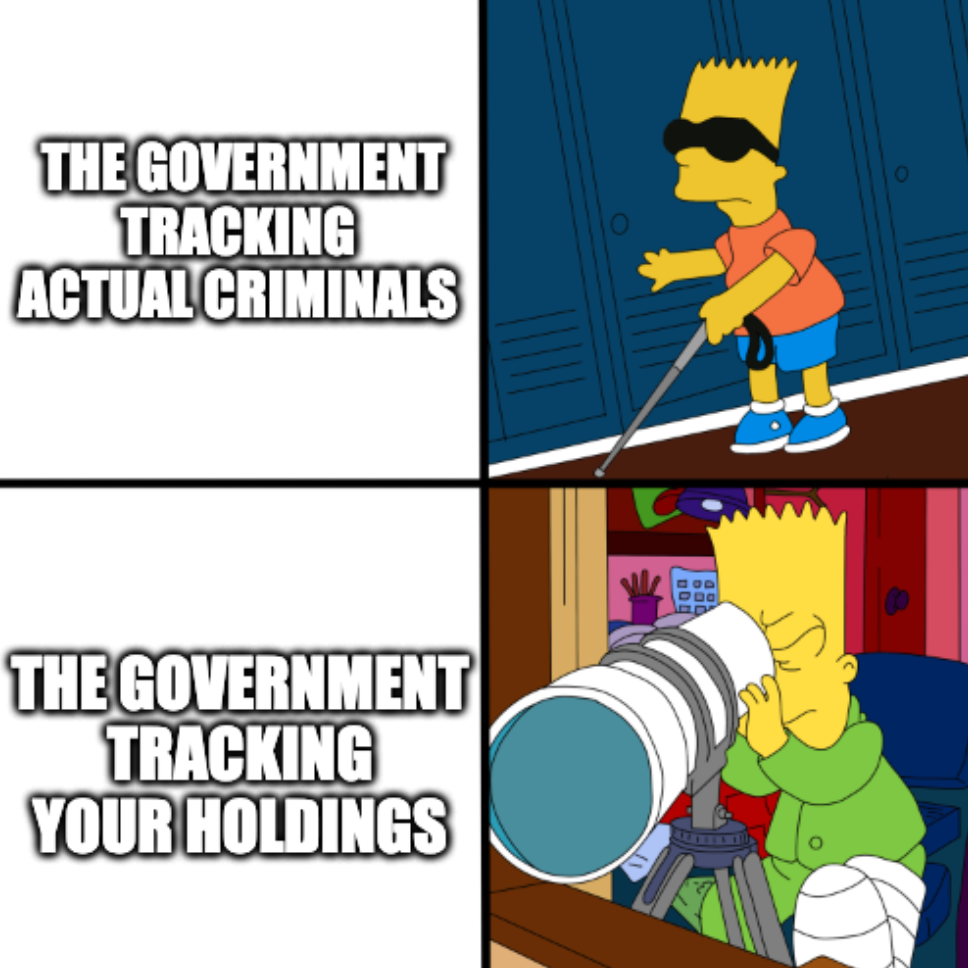
This changes the game. Holding is no longer purely passive. Moving is no longer frictionless. Waiting is no longer a strategy you can rely on indefinitely. The system doesn’t need you to make a mistake or forget to report something. It only needs a clear view of your position.
And increasingly, it already has one.
When the Exit Starts Closing
In 1961, East Germany built the Berlin Wall. Not to keep people out, but to stop them from leaving.
Up to that point, walls had a clear purpose. They protected cities from invasion, kept enemies at bay, and marked the edge of a territory. The Berlin Wall inverted that logic. It was built by a system that could not afford to let its own citizens walk away.
That distinction matters. Because it reveals what happens when a system becomes economically fragile and politically dependent on control. Movement, which once seemed natural and uncontroversial, becomes something to monitor and eventually restrict.

As wealth becomes more mobile and individuals gain the ability to operate outside traditional structures, states are forced to respond. Some will compete, whereas others will tighten their grip.
You are already seeing the early stages of this process. The hard reality is that many Bitcoiners are underprepared. They have secured their assets, but left everything else exposed. They sit inside jurisdictions that are turning the screws tighter every year, all while comforting themselves with the idea that they’ll just “move” or have a “boating accident” when things get bad.

That comforting little fantasy will not age well. Sovereignty, in practice, isn’t just about holding your own keys. It is about having credible options for where you live, how you are taxed, and under which rules you operate.
Bitcoin gives you the ability to opt out of the monetary system. It doesn’t automatically give you an exit from the jurisdictional one. And if the last century has shown anything, it is that waiting until a system starts closing its doors is the worst possible time to look for another way out.
What Being Early Actually Looks Like
Once you recognize the direction of travel, the conclusions become simple. You can’t sit and hope for the best, you need to secure jurisdictional optionality before you need it.
You can’t assume flexibility will still be there when you need it and you can’t leave critical decisions to the point where the system is already tightening around you. You have to act early, and act deliberately.

That starts with recognizing that jurisdiction isn’t some minor detail. It’s one of the main variables that determines how much of your wealth you keep, how easily you can move, and how exposed you are to the system you are trying to distance yourself from.
Most people approach this backwards. They wait until something changes, then react. By that point, the options are narrower, the costs are higher, and the mistakes are harder to undo.
A second residency gives you something concrete: another place where you can legally live, operate, and begin reducing dependence on a jurisdiction that is becoming more hostile, extractive, and unstable. Remember, a single jurisdiction is a single point of failure.
For many people, Panama is one of the clearest places to start. It offers a practical route to residency, a relatively straightforward process when handled properly, and a credible base outside the tightening tax and reporting regimes now spreading across the West. We documented part of that process in our article An Adventure in Panama.

This is where most people need help, because the difference between having a real option and a half-finished plan usually comes down to execution. Timing matters, sequencing matters, and the jurisdiction matters. A rushed move, or a badly structured one, can create exactly the kind of tax exposure and friction you were trying to avoid in the first place.
We work with clients to build that structure properly from the start. That includes secure Bitcoin self-custody, reducing unnecessary exposure, and, where relevant, establishing a second jurisdiction that actually works in practice.
If you want to understand what securing a residency like this could look like in your specific situation, the best place to start is a conversation.
If you’re serious about this, you can book a free 30-minute consultation where we walk through the process, your options, and how to approach it properly.