
Taxing Phantom Profits - The Netherland’s War on Wealth

In this article:
Do you ever wish you could be paying more taxes? Are you concerned about building wealth, when talented bureaucrats could be redistributing it to ‘improve’ society instead?
Well fear not, because the Netherlands has just devised an entirely new set of tax laws to make sure you never have to worry about being wealthy again. The Dutch House of Representatives just passed an Act that plans to introduce a 36% tax on unrealized capital gains as of January 2028!
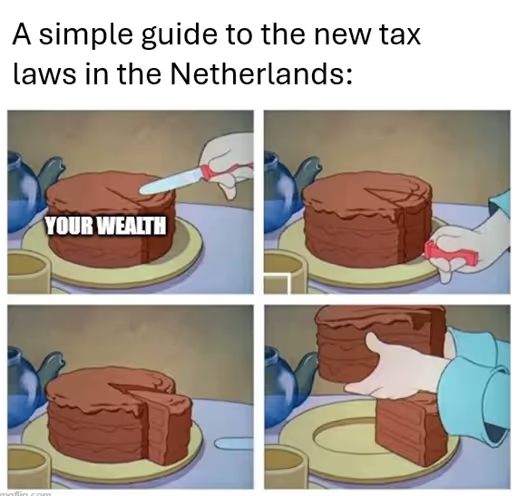
That’s right, the Netherlands has decided they don’t just want to tax your income, they also want to impose taxes on money you’ve never received, from profits you haven’t realised, on paper gains that could evaporate tomorrow.
Under the new rules, investors will be required to pay an annual tax on the increase in value of any liquid assets like stocks, bonds, cryptocurrencies, and savings, even if they haven't sold or received any income from them.
In simple terms, the Dutch government plans to tax its citizens just for owning things that increase in value against an infinite Euro. (Which is basically everything).
What could possibly go wrong?
The bill is expected to pass the Dutch Senate without much resistance, which means Dutch citizens will be subject to these rules in less than 2 years. That’s not much time to prepare, but that’s intentional. When governments decide to close the exits, they do it quickly, to trap as many people as possible.
The only people who will manage to escape these new taxes are the ultra-wealthy or those smart enough to have already put contingencies in place.

This week we’ll attempt to make sense of the nonsensical to illustrate what these new tax laws mean in practice, the impact they will have on ordinary citizens, and how to best protect yourself if your government decides to do the same.
(Hint: They will)
The Fall of a Trading Empire
To watch the Netherlands capitulate to such deranged economic policy is a real tragedy.
In the 17th century, Dutch merchants built one of history’s most impressive commercial empires. They launched the world’s first stock exchange, the Dutch East India company became the world’s first publicly traded corporation, and Amsterdam rose to become the financial centre of Europe.

None of this was achieved by accident. It happened because the Netherlands understood that property rights and economic freedom are what lead to prosperity. Dutch merchants risked their capital, sailed treacherous seas, and built trade networks that spanned the globe, simply because the right incentives were in place. When people are allowed to keep what they earn, and can benefit from what they own, society thrives.
Unfortunately, this former economic powerhouse is now trying to destroy the very concept of capital appreciation that once led it to greatness, and by doing so, stifle the fierce entrepreneurial vigor that the Dutch people are so well known for.

These taxes will wreak havoc on the Dutch economy. Those who support them believe they’re helping people in need, by redistributing wealth. What they’re too shortsighted to recognize, is that they’re taxing success to do it. In fact it’s worse than that, under these new proposals, they plan on taxing unrealized success.
Why would anyone build a business under a regime like that? Why allocate capital to a market that taxes you before you’ve even realised a profit? This will make the Netherlands deeply uncompetitive, force the wealthy to flee, and leave Dutch investors at a severe disadvantage when it comes to building wealth.
If you remove the incentives to speculate, be productive, and create wealth, everyone loses. This isn’t wealth redistribution, it’s wealth destruction, and the whole economy will pay the price.

Unrealized Gains Taxes – The Mechanics of Madness
Taxing unrealised gains is as stupid as it sounds. It’s an attempt to tax something that doesn’t yet exist. The best way to illustrate just how crazy these new proposals are is to lay out a demonstration of how they might work.
To do that, let’s assume the role of a 17th century Tulip investor, and run some imaginary numbers to see how these taxes would impact our investment performance:
- Step 1: Let's imagine it's January 1st, 1636, and caught up in the hype of the century, you decide to buy 500 tulip bulbs worth €100 each. Your total portfolio value starts at €50,000.

- Step 2: By December 31st, 1636, your tulips have had a good year. They're now worth €150 each and your total portfolio value has risen to €75,000. You made a paper gain of €25,000! Nice!
- Step 3: You don’t sell anything, because in your mind there’s no way this is a bubble. Everyone knows tulips are going to the moon baby!
But the taxman doesn’t care whether you sold or not, and taxes your unrealized capital gain of €25,000 at a rate of 36%, which means you can expect a bill of €9,000 to arrive soon.
- Step 4: Come May 1637, your tax bill arrives and you owe €9,000 immediately. In cash.
There’s just one problem. The tulip bubble burst in February, and their value has since wilted back to just €110 each. Your portfolio is now worth €55,000, only €5,000 more than you started with.
Unfortunately, the tax man isn’t interested in that. The gain was calculated on December 31st, 1636, and you’re still on the hook for a €9,000 tax bill.
- Step 5: You don’t have the cash on hand, so instead you’re forced to sell 82 tulips at €110 apiece to cover your tax bill.
You started with 500 tulip bulbs, and you’re now left with 418.
Now with only 418 tulips left, your portfolio is worth €45,980. Despite the tulips being more valuable than when you bought them; you ended up losing money.
Only a PHD economist could possibly think this makes any sense. Despite making a paper gain of €5,000, the investor in our example ends up €4,020 worse off than when they started, while holding 16% fewer tulips.
Quite miraculously however, the government found a way to trouser a whopping €9,000 in tax and was the only one to come out ahead.

Now take the same example and replace ‘tulip bulbs’ with ‘Bitcoin’. Whilst we’re not comparing Bitcoin to the tulip bubble (we’re not the mainstream media), we have to accept that Bitcoin has volatile price swings. We’re experiencing one right now.
That means as a Dutch Bitcoin hodler, you could find yourself in the same situation as our tulip investor. If the market moves against you at an inopportune time, your Bitcoin stack could be eroded by paying taxes on imaginary gains that have long since evaporated.
Imagine a world where your Bitcoin stack decreases not because you sold, but because of taxation.
Fiat’s Final Act of Theft
When your government debases the currency, the only rational response is to put your money into real assets that maintain value while paper money loses it. That’s why for decades anyone with sense has poured their wealth into things like real estate, stocks, precious metals, and most recently, Bitcoin.
Buying real things was the last line of defense against monetary destruction.
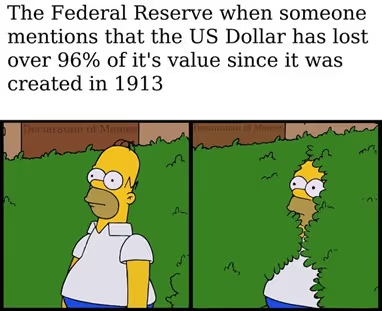
The Netherlands is now closing that escape hatch.
As the ECB continues to print money, the Euro will continue its inexorable march toward zero. That means that anything of real value must appreciate against it in nominal terms. Your assets are guaranteed to increase in price, even if they haven’t really increased in real world purchasing power.
Your house might have doubled in price, but so did everyone else’s. You can still only afford one house.
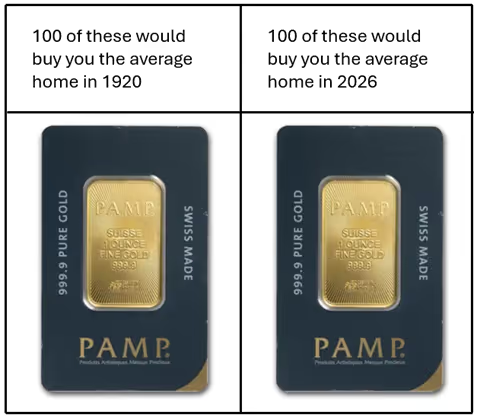
Even though none of this asset-based inflation is creating any real wealth, with the introduction of unrealised gains taxes, the Dutch government is trying to treat it as “income” despite you never receiving it or benefiting from it.
This is a game designed for you to lose. If you hold cash, it gets eaten by inflation. If you buy assets, they will tax you on phantom gains caused partly by the monetary inflation they created. It’s heads they win, tails you lose.
This is how you create a permanent underclass. Trap them in depreciating currency with no escape route. The government wants you to “own nothing and be happy”.

As socialist governments continue their slide toward full-blown communism, and start running out of other people’s money, you can expect to start seeing an increasing amount of pernicious taxes being introduced. The Netherlands won’t be an isolated case.
Germany has already extended tax liability after emigration, countries like France and Norway already have exit taxes, and Denmark has proposed applying a 42% unrealised capital gains tax specifically to cryptocurrencies. The co-ordination isn't a coincidence; it’s a containment strategy. The OECD has been harmonizing tax policy across nations for years. They're building a cage.
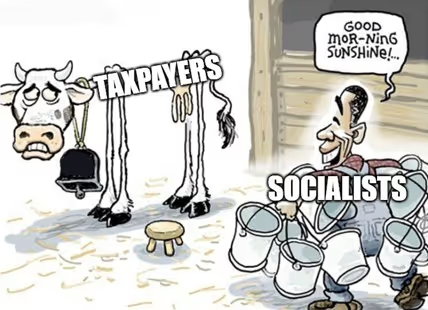
They want you to become a free-range human living on a tax farm.
How to Protect Yourself
It has never been more important to start thinking about how to protect your wealth from the state. Every single Western Government is drowning under an insurmountable mountain of debt that will never stop growing.
They are flat broke and the interest payments are becoming eye watering. If these were your personal finances, you would have already declared bankruptcy.

Governments only have two ways to square this circle. The first is to default, let everything crash and burn, and start all over again. The other is to print an absolutely absurd amount of money and kick the can further down the road.
History shows they always choose the latter because it’s more politically popular. A financially illiterate population will choose death by a thousand cuts instead of ripping off the band-aid. As they get poorer, they will demand more handouts, and that will only make the problem worse. and vote for any politician that will oblige them.
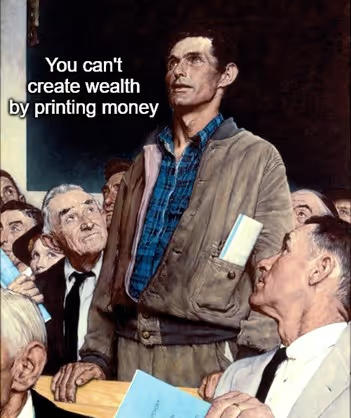
Printing money doesn’t create wealth.
Your increasingly insolvent government won’t stop at just printing money to try and plug the holes in their dying ponzi scheme. There will be no limit to their stupidity and greed. Once your money has become worthless, they will come for your property next.
It’s time to start taking steps to protect yourself. Here’s the best place to start:
1) Hold Bitcoin
When governments are printing money, you can’t save in cash if you plan on maintaining your wealth over the mid to long-term.
Bitcoin is the obvious choice. It’s not just scarce, it’s verifiably scarce, and as time goes on, it’s only going to get harder to acquire.
2) Self-Custody Your Bitcoin
When governments start trying to steal your property via taxation or even more direct means, they will raid the third-party custodians first. If your wealth is managed by a regulated institution, you are completely at your government’s mercy. Your custodian will bend the knee at the first sign of pressure.
Bitcoin is hard money you can hold with zero counterparty risk, and unlike gold it isn’t cumbersome or conspicuous to move around. It is by far the best option for taking your wealth off the table and putting it outside a system trying to steal it.
3) Acquire Non-KYC Bitcoin
The easiest property to protect is the property nobody knows you own. Privacy is not a crime, and it is perfectly reasonable for you to be using non-KYC services or peer-to-peer exchanges to acquire Bitcoin.
In 2026, if you haven’t already started a non-KYC stack, you’re not as well prepared as you could be.
4) Improve Your Privacy
Governments operate like a business. The easier you are to track and target, the more likely they are to try and track you down and extort you. Learning to buy non-KYC Bitcoin is a start, but you should be seriously considering upgrading both your Bitcoin and your online privacy.
The less footprints you leave the better. Learning how to use privacy tools is an important part of protecting your wealth that most people do not consider carefully enough.
5) Develop an Escape Plan
The best way to escape a tyrannical government is to move outside their jurisdiction. There are plenty of Bitcoin friendly countries eager to tempt you to their shores by respecting your property rights, offering sensible taxation policies and respecting your way of life.
Even if you’re not looking to relocate today, the smart move is to be prepared. Already having a plan B in place before your government decides to tighten the screws means you have options when the time comes.
Staying trapped is a choice.

Protect Your Wealth – The Bitcoin Way
People first look to Bitcoin to increase their wealth. But the more you understand it, the more you realize it’s actually designed to protect it. You can secure it safely with no counterparties, hold it privately without anyone knowing, and traverse borders with it without anybody stopping you.
It’s called freedom money for a reason.

That’s why it’s so important that you learn how to use it properly. Leaving it with a third party or investing in it via proxy stocks or ETF shares means you don’t access any of its key benefits. You have a candy wrapper with no chocolate inside.
The bottom line is, if you want to be well positioned for the future, then at a minimum you need to learn how to take proper self-custody, run your own node and manage your UTXOs. Then once your first taste of freedom leads to a hunger for more, you can move on to learning about cybersecurity, non-KYC, and even plan B residencies.
The stakes are high and time is short. Take your first steps towards true freedom today. Book a free 30-minute consultation with one of our experts to get started.