Bitcoin Meets AI - Are You Prepared?

In this article:
For more than a decade, Bitcoiners have pontificated about what the world will look like when Bitcoin and AI inevitably start to converge.
Large language models (LLMs) have shown us what to expect when we give ‘intelligent’ machines access to large data sets, but what happens when we start giving them access to permissionless peer-to-peer money?
The mind boggles…
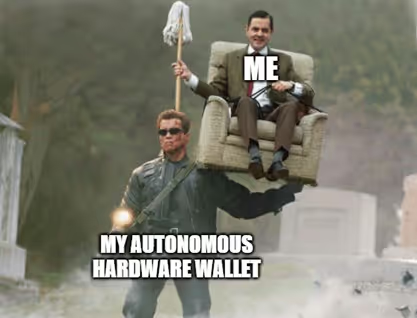
We already know that AI is an incredible tool for learning new skills, improving the quality of your work, or even helping you grow your business. But it still suffers from a major constraint…
Until banks start letting robots open their own bank accounts, AI still needs a ‘human in the loop’ to perform real world financial transactions using your money. Just like the people still trapped within the fiat system, they need permission to engage in any ‘real’ economic activity.
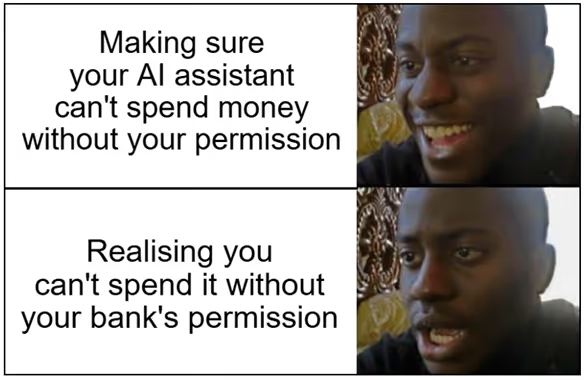
That’s what makes the intersection between Bitcoin and AI so interesting. The fiat financial system is permissioned, and not readily accessible to AI, whereas Bitcoin is permissionless, and doesn’t discriminate between humans and machines.
With Bitcoin, AI agents no longer need to piggyback on the bank accounts of their human handlers, they can become their own bank, manage their own wallets, and have direct control over their own economic activities.
It looks like even the robots won’t have to ‘own nothing and be happy’

AI agents becoming autonomous economic players within society is no longer just a pipe dream, it’s something that’s already possible using the tools we have available today. At some point in the near future, you might even find yourself doing business with one!
What does that mean for society? Well, nobody really knows yet, but the impact is likely to be profound. So this week, let’s explore what the intersection between AI and Bitcoin looks like today, and where we might be headed next.
What is an AI Agent?
Most people are already familiar with LLMs like ChatGPT or Grok where you can start conversations, ask questions, and receive helpful guidance on the problems you’re working on.
AI agents however work slightly differently. Instead of just talking to you and providing responses to individual prompts, they can actually do things and execute tasks without requiring constant direction and management.

The key difference boils down to access. While LLMs are confined to their conversation window, AI agents are given a deeper level of access to your system which allows them to open applications, navigate your file system, click buttons, and interact with websites.
They can:
- Work independently: You can give your AI agent a broad goal, and it will figure out and execute the individual tasks required to reach it without constant user intervention. It might even create more AI agents to help out!
- Access your tools: Given the right permissions, AI agents can access and manipulate files on your computer, read and respond to your emails, manage your calendar, or even call your favourite restaurant to make a reservation. The possibilities are endless.
For example, you could tell your AI agent to invite all your friends to dinner, handle the RSVPs, make a reservation for the corresponding amount of people at your favorite restaurant, and then book an Uber to get you there on time!
- Remember and learn: A big frustration with standard LLMs is that they lack persistent memory. If you engage in a long enough conversation they lose will lose the thread, forget past discussions and conclusions, and their responses fall out of context.
In comparison, AI agents maintain context about your preferences, past interactions, and ongoing projects, making them more effective at solving complex problems over time. You won’t have to tell it what your favorite restaurant is again, it will remember!
- Operate continuously: Unlike LLMs, AI agents can operate 24/7 even when you’re not directly engaging with them. They can monitor and respond to your emails, post content on social media, or even write code while you’re still fast asleep!
If you wanted to, you could let your AI agent decide what you eat, which events you attend, what tasks you work on, and even which personal relationships you should be investing in.
Just be careful you don’t get too carried away…

Could an AI Agent use Bitcoin?
Given that AI agents can use any software you give them access to, there’s no reason they couldn’t successfully operate a Bitcoin wallet located on the same device. The wallet wouldn’t even need to exist already; with the right permissions your AI agent could independently download and install its own Bitcoin wallet, and even start running its own full node.
In many ways, an AI agent is significantly easier to orange pill than most humans.

In practice, that means your AI agent can not only perform tasks for you autonomously, but also start taking payments and making purchases on your behalf as well. This creates some crazy possibilities. Imagine a world where you can give your AI agent instructions like this:
Step 1) Download a Bitcoin Wallet and secure the private key in an open-source password manager.
Step 2) Send me a Bitcoin address to fund your wallet with some initial seed money.
Step 3) Create an online store selling digital courses like e-books or video tutorials. Do some research and choose a profitable niche. Use the seed money to pay for expenses, subscriptions or freelancers as required.
Step 4) Take payment in Bitcoin only and use Zaprite for invoicing. At the end of each month consolidate the profits into a single UTXO and ask me for a Bitcoin address to send it to cold storage.
Of course, this is just an example, and building a functioning business could never be as simple as 4 basic prompts, but hopefully it illustrates the point. Bitcoin allowing AI agents to become autonomous economic actors will unlock an entirely new form of 24/7 commerce and instant value transfer that will reshape the entire global economy.
It's all quite exciting, just be careful you don’t get too caught up in the hype. An AI agent is just a useful tool, not a magic money printer. You can give a chimpanzee a hammer, but that doesn’t mean it can build you a house.

The Risks Associated with AI Agents
The last couple of weeks have seen an explosion of interest in AI agents. Especially since the recent launch of an open-source AI agent known as OpenClaw (formerly known as Moltbot and Clawdbot).
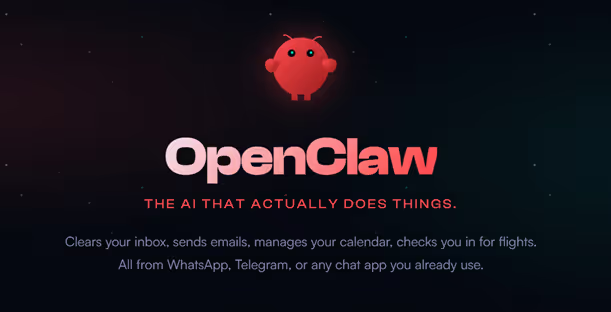
OpenClaw is an AI agent you can install either on your own device or on a rented Virtual Private Server (VPS). It is model agnostic and interfaces with all the best-known AI models available (Claude, GPT-4, Grok etc) giving users the flexibility to choose which “brain” powers their assistant.
What’s particularly interesting is that OpenClaw can even connect to multiple AI models at once and select which one is best (or cheapest) to perform the current task it's working on. It can even create multiple sub-agents running different AI models to suit each of their respective roles.

OpenClaw went viral shortly after release. Hordes of influencers are now ‘building in public’, tweet threads are flying, and YouTube videos are being pumped out at a ferocious speed. Based on Github and NPM downloads alone, there are already more than 500,000 OpenClaw users, and that number is rising fast.
The excitement is palpable, and everyone thinks they’re going to be the next Tony Stark.

It’s easy to get excited about AI agents and start dreaming about all the ways they might improve your life, but you should proceed with extreme caution. They come with significant security risks.
AI agents are most useful when they know a lot about you, but the more they know, the more dangerous they become. Running one that knows all the inner workings of your life, your thoughts, your business, and your whereabouts, is a serious security risk. Your friendly and persistently online assistant knows all your important secrets. You’re in big trouble if someone can get it to spill the beans.

Unfortunately, a lot of people are diving in with reckless abandon. They’re giving OpenClaw access to personal email accounts, filesystems, and system-wide controls, without fully understanding the risks, and without taking the proper security measures.
Security researchers are already discovering hundreds of OpenClaw instances running with open ports, no gateway authentication, and no firewall protection, making it trivial for attackers to gain unfettered access to the machines they’re running on.
And even those who do know how to secure their agents properly still face the ever-present threat of prompt injection attacks, where attackers email or message you knowing that your bot will read it, so they can feed it malicious prompts giving them control instead of you.

The point is, agentic AI isn’t something you should tinker with casually, and certainly not something you should install on your primary devices. If you do feel the need to explore this kind of tech, always bear in mind that you’re playing with technology that’s right at the bleeding edge. A lot of the security issues are still unknown, and given the way AI agents work, any compromises could be catastrophic in nature.
If you must experiment, then tread carefully and do so in a sandboxed environment with dedicated devices that are not linked to your home network. Also consider that any information you do feed to your bot could at some point become compromised. Remember, these agents can act autonomously, so think carefully about the information and access you share with them.
There could be unintended consequences…

In 2026 we’re expecting to hear countless stories of exploits suffered by cavalier AI pioneers that neglected to properly secure their data. Things get even more concerning when you realize that even if you don't use AI agents yourself, a friend could be leaking your contact details and private messages through their own insecure bots without you even knowing!
Bitcoin and AI are both powerful weapons that can be leveraged to improve your life and maximize your freedom, but like all weapons, they can be dangerous if not used correctly. Wielding either of them without taking a careful approach to information security and online privacy is even more reckless than not using them at all.

Become Future Proof – The Bitcoin Way
The rapid progression of AI agents is both exciting and terrifying at the same time. Learning how to use it properly could give you a significant edge, but play with it carelessly and you could end up making a fatal mistake.
AI is going to create lots of new opportunities, but it will also create entirely new security threats. That’s why it has never been more important to ensure that your Bitcoin and private information are secured properly. The robots already know how to use Bitcoin, and they’ll take it from anyone foolish enough to make it accessible.
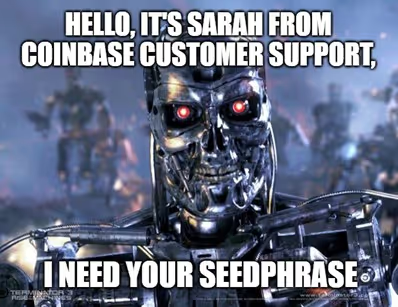
Thankfully, there are ways to secure your wealth and sensitive information in a way that even AI can’t compromise, and our experts can teach you how. You don’t need to face the robots alone, becoming one of our clients means you will always be one step ahead of any new threats that emerge.
All you need to do to get started is book a free 30-minute consultation.
Come with us if you want to live.