When Governments Get Desperate, Money Gets Political
In this article:
Do you ever find yourself wishing geopolitics felt a little more stable? Perhaps you miss the good old days when “breaking news” meant a celebrity scandal rather than airspace closures, oil shocks, and the faint drumbeat of escalation in the Middle East.
The world is once again reminding us that peace is really just a temporary pause between conflicts and monetary adjustments.
The latest tensions involving Iran have sent the usual signals rippling through the global system: energy markets are shaking, commentators are shouting, politicians are posturing, and central banks are quietly preparing their talking points about liquidity support and stability tools. It’s all very familiar, but it never feels comfortable.
Fear, uncertainty and doubt are everywhere, and most people find themselves caught in a doom loop of monitoring a situation they can’t control.

Now, before we go any further, let’s be clear about something.
This isn’t a prediction of world war, and it isn’t an invitation to panic. Bitcoiners, of all people, should understand the value of staying calm while everyone else loses their heads.
So, this week, let’s spend some time understanding the financial mechanics of war, why Bitcoin is your best defence, and how to properly position yourself.
How Modern Wars Are Funded
It’s worth asking ourselves a simple question: how do these eye wateringly expensive modern wars actually get funded ?
Because they certainly aren’t funded the way they were a century ago, when governments had to raise taxes immediately or physically borrow hard money from willing citizens before marching off to battle.
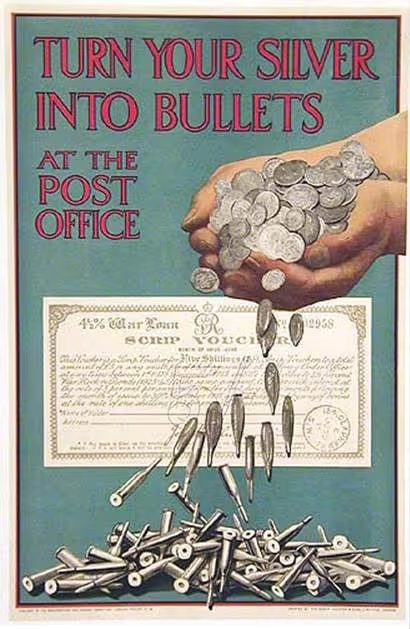
Today, governments no longer need to pass the hat around the town square before heading into conflict. Instead, they can issue bonds, lean on central banks to keep yields under control, and allow deficits to expand under the comforting banner of economic support. The spending happens now; but the consequences are smoothed out over years through higher debt loads and a currency that gradually buys a little bit less year on year.
It’s a remarkably elegant system, at least if you’re the one doing the ‘spending’ or its more conventional name, stealing.
The Day the Bond Market Needed a Buyer
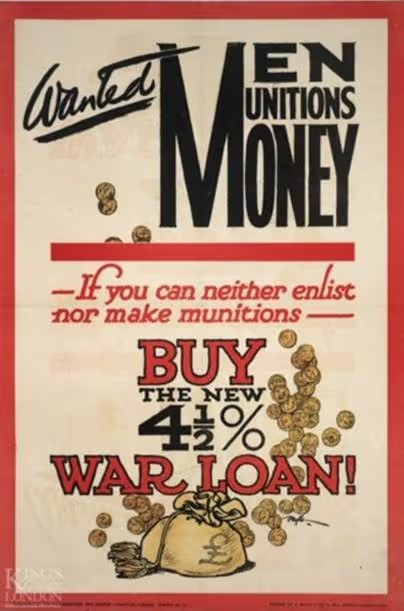
It’s worth remembering that this isn’t a new phenomenon, in November 1914, Britain needed £350 million to finance the First World War - an enormous sum at the time. The government launched what was known as the War Loan, offering 4.1% interest over ten years, hoping patriotic citizens would enthusiastically fund the effort.
Surprise, surprise. They didn’t.
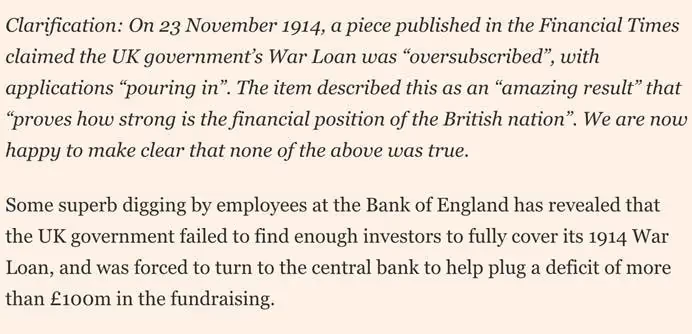
The bond raised barely a quarter of what was required. Fewer than 100,000 investors subscribed, a disappointing outcome for a nation at war and a Treasury in need of confidence. The bonds didn’t quite fly off the shelves, so the Bank of England did what any responsible institution would do: it quietly bought a sizeable chunk itself and declared the launch a success. Confidence restored. Nothing to see here.
Newspapers reported the issue had been oversubscribed. Stability was preserved. The war could proceed without the awkward inconvenience of visible financial hesitation from the public.
You can call it crisis management. You can call it “masterly manipulation”, as one contemporary memo did. But whatever label you prefer, the lesson is clear: when war requires funding, monetary systems have a habit of becoming… flexible. And that flexibility is a feature not a bug.
When Money Stops Being Neutral
The important point isn’t simply that governments can finance conflict more easily today than they could in 1914. You’ve already seen that. The more subtle shift is what happens once money itself becomes a policy instrument rather than a neutral yardstick.
Money stops being purely yours.
In periods of calm, that distinction feels academic. Your bank account works, transfers clear, and markets function. The system appears neutral and frictionless. But in periods of strain (geopolitical, fiscal, or otherwise) neutrality tends to give way to strategy.
Sanctions start getting imposed, payment networks become restricted, assets get frozen, and capital controls are introduced “temporarily”, which in political language can mean anything from weeks to permanently.
None of this requires cartoon villains. It simply requires a little bit of stress to be applied to the system, and when that stress arrives, it has a habit of revealing which parts of the system are actually conditional.
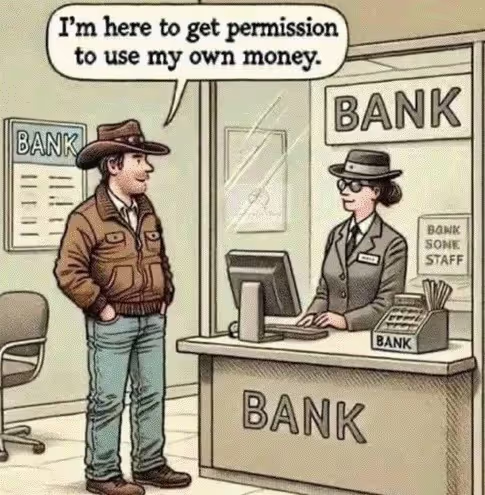
The uncomfortable reality is that most modern wealth is jurisdiction-bound. It lives inside banks that answer to regulators, brokerages that operate under national law, and payment systems that can be switched off or restricted when circumstances demand it.
The Mobility Question
This leads us to a question that feels uncomfortable, so most people avoid asking it.
If circumstances forced you to relocate - not as a lifestyle choice, but as a necessity, how much of your net worth could move with you without requiring approval from an intermediary?
Your home is immovable. Your pension depends on policy. Your brokerage account relies on functioning intermediaries and cooperative infrastructure. Even your bank balance ultimately sits within a framework that can impose reporting requirements, transfer limits, or outright freezes under emergency authority.
You might be holding some precious metals with no counterparty risk, but good luck getting them out of the country.

We like to imagine our wealth is global. In practice, much of it is national with excellent branding. That doesn’t matter when the world is calm. It matters when it isn’t.
And this is where the conversation shifts from abstract macroeconomics to personal sovereignty. The same monetary flexibility that makes prolonged deficit financing possible, also creates a system in which financial mobility is conditional. Most of the time that condition is invisible. But in times of conflict, it reveals itself.
This is not a call to paranoia. It is simply an acknowledgment that we live in an era of rising geopolitical fragmentation, government control, and censorship. Alliances will shift, sanctions will multiply and financial networks will become increasingly entangled with domestic and foreign policy.
It’s imperative we recognise how just easily our wealth can become inaccessible.
Bitcoin - Constraint for Governments, Optionality for You
At the macro level, Bitcoin introduces a hard constraint. Its supply cannot be expanded to smooth over fiscal strain or to quietly absorb the cost of prolonged military engagement. There is no central authority capable of increasing issuance to stabilise a bond market or accommodate a widening deficit.
On a fixed monetary base, spending must be matched by real resources, and trade-offs become immediate rather than deferred. This friction matters.
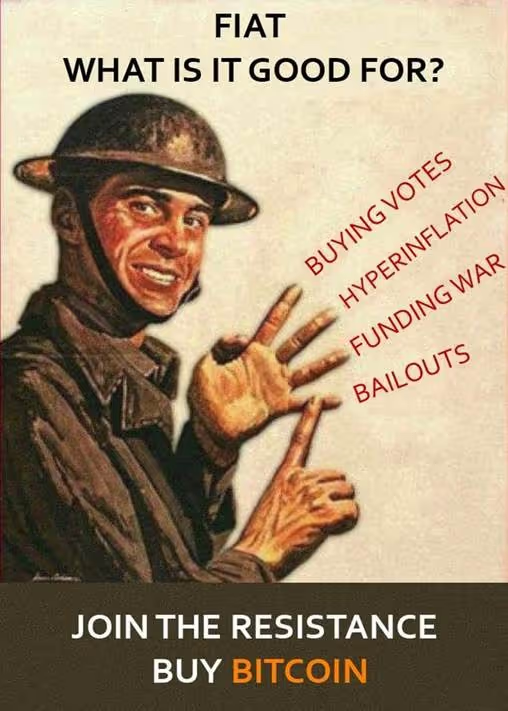
When the cost of war must be borne transparently, through taxation or through voluntary borrowing from savers who demand credible returns, political appetite is naturally more constrained. Bitcoin does not eliminate the possibility of conflict; human incentives are more complicated than that. But it does remove one powerful mechanism: the ability to distribute costs invisibly through currency dilution.
Bitcoin held in self-custody cannot be debased and doesn’t require state approval to move. It is not tied to a single jurisdiction’s banking system, nor does it depend on a specific payment rail remaining open. Properly secured, it represents a form of wealth protection and monetary portability that did not exist for ordinary citizens during previous eras of geopolitical stress.
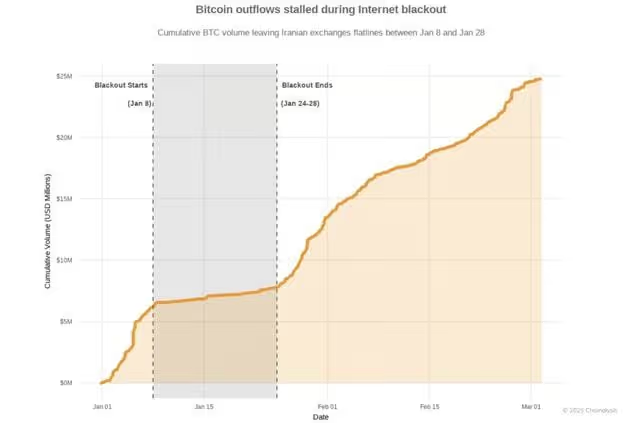
But do bear in mind, you must hold it in self-custody to reap these benefits. The graph below shows that users in Iran who left their coins on an exchange during recent internet blackouts learned this the hard way.
Fiat systems make large-scale conflict financially manageable for states. Bitcoin makes large-scale uncertainty financially manageable for individuals. Those are not symmetrical powers, but they are related. One lowers the cost of war. The other lowers the cost of exit by making your wealth portable, permissionless, and harder to seize.
In an increasingly uncertain world, being able to opt-out is a superpower.
Pay Attention, Take Action
If monetary systems can stretch to finance conflict, they can stretch in other directions too. History suggests that when governments face fiscal pressure, they don’t suddenly become more disciplined. They become more creative.
Inflation, financial repression, windfall taxes, capital restrictions, “temporary” emergency measures that seem remarkably good at becoming permanent. Their creativity knows no bounds. Governments aren’t great at most things, but they excel at creating new ways to tax you.
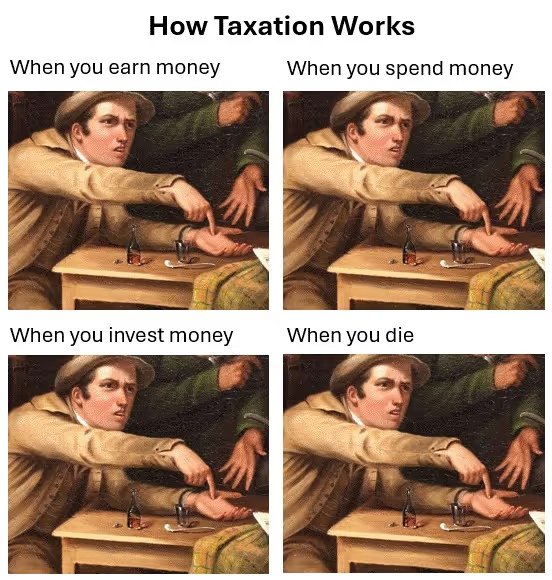
But this isn’t the time to panic, this is the time to work on your positioning. If you intend to preserve your sovereignty in an era where money is becoming increasingly political, then there are some baseline steps that are no longer optional.
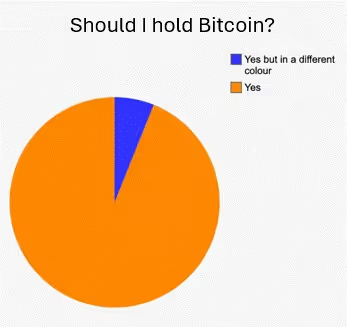
1) Hold Bitcoin
When governments can expand the money supply to finance deficits, saving in fiat currency exposes you to slow confiscation via dilution. Bitcoin is different. Bitcoin operates on a different foundation: absolute scarcity. Its supply schedule is enforced by the network itself, not revised by committees when political pressure demands “flexibility”.
In a world built on soft money, Bitcoin restores monetary integrity. So, if you are serious about protecting your savings from debasement, you need exposure to the asset that cannot be printed. You need to hold Bitcoin.
2) Take Proper Self-Custody
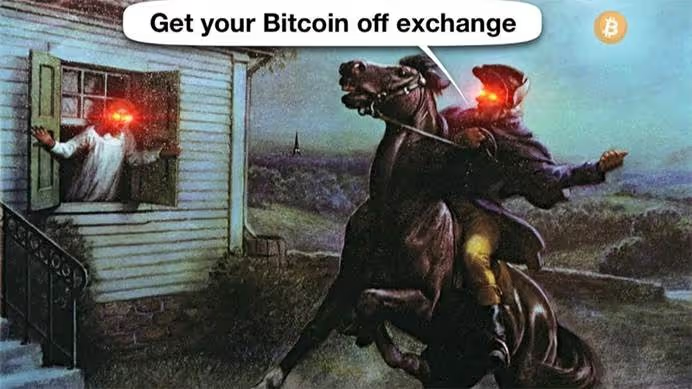
If geopolitical tension teaches us anything, it’s that intermediaries will always comply. Banks comply. Exchanges comply. Custodians comply. They are regulated entities operating within permissioned geographic jurisdictions. When pressure comes, they do what regulated entities always do, they follow government instructions.
Self-custody removes that counterparty risk. Bitcoin in cold storage is not a promise. It is not an IOU. It is not dependent on someone else’s solvency or political alignment. It is yours. And that distinction becomes more important as uncertainty rises.
Without taking self-custody, Bitcoin can’t protect you. You must take your Bitcoin off the exchanges.
3) Think About Mobility Before You Need It
The worst time to design an exit plan is when you require one. That doesn’t mean you need to relocate tomorrow. It means understanding the mechanics of moving value across borders without relying entirely on traditional financial rails.
It means knowing how your backups work, understanding operational security, and reducing unnecessary footprints. Mobility is a skill. And like any skill, it’s easier to develop when the stakes are low. Remember, you cannot control geopolitics. You cannot dictate central bank policy. You cannot prevent governments from using the tools available to them. But you can choose whether your entire financial life sits inside a system whose incentives are not aligned with yours.
Fiat makes prolonged conflict easier to finance. Bitcoin makes prolonged uncertainty easier to navigate.

From Exposure to Ownership – The Bitcoin Way
You can secure Bitcoin without counterparties, hold it privately, move it across borders, and verify its scarcity yourself. But only if you learn how to use it properly.
Leaving it on an exchange, buying exposure through a proxy ETF, or treating it like a speculative investment might give you price exposure but it doesn’t give you sovereignty.
If you want to position yourself properly, then start by learning the fundamentals of self-custody, node operation, and privacy hygiene. And if you’d rather not figure that out alone, Book a free 30-minute consultation with one of our experts. We’ll guide you through building a setup you understand, control, and can rely on.
Position yourself before you need to.