
What Is Sound Money? A Complete Beginner's Guide

In this article:
Historically, societies have relied on money to facilitate trade, measure economic activity, and store value. But not all money is created equal, and few people wonder if the money they earn, save, or spend is reliable.
Governments print more of it, banks expand credit, and monetary policy can change overnight, all of which determine whether your wealth holds or erodes over time.
The concept of sound money originated as a response to this problem. This is a form of money that facilitates trade honestly, resists manipulation, and preserves value. It's a standard that matters more now than ever for anyone caring about financial sovereignty.
Gold served this role for centuries. Today, the debate has expanded to include bitcoin. Read on to learn what sound money is, why gold held the standard for centuries, how fiat currencies replaced it, and why bitcoin arguably meets the criteria today.
Key Takeaways
- Sound money holds its value because its supply follows rules that no single entity can change.
- Gold served as the standard for sound money for centuries because of its limited supply, so no one could flood the market and devalue it.
- Fiat currencies struggle to meet these criteria because central banks can expand supply, eroding purchasing power through inflation.
- Bitcoin is often described as sound money because of its fixed supply of 21 million, decentralized issuance, and resistance to political interference.
The Gold Standard
For centuries, gold was the anchor of the global monetary system, and for good reason. It naturally possessed the properties that sound money requires. It was divisible, durable, portable, scarce, and widely acceptable. No single government could create more at will, which helped preserve purchasing power over time.
Under the gold standard, paper currencies were redeemable for a fixed amount of physical gold. Each unit of currency represented a specific weight in gold, which kept exchange rates stable and facilitated international trade. Governments could only issue as much currency as their gold reserves backed, making it difficult to expand the money supply at will.
This structure kept prices stable over time. It also enforced fiscal discipline, as countries couldn’t print their way out of deficits without draining their gold reserves. Gold’s high stock-to-flow ratio meant that above-ground supply exceeded the amount slowly entering the market through mining.
However, the gold standard wasn’t perfect. It restrained governments during crises when flexibility was needed. Still, its core virtue was that money supply stayed anchored to something real rather than to government decree.
The system gradually collapsed. Its abandonment by most governments between the early 1930s and late 1970s marked the beginning of the fiat era.
.jpg)
The Shift to Fiat (And What Went Wrong)
The shift from the gold standard to fiat happened after World War II, when the global financial order was reorganized under the Bretton Woods Agreement of 1944.
Under the agreement, major world currencies were pegged to the U.S. dollar, while the dollar itself was pegged to gold. The system preserved the link to gold while giving the U.S. a privileged position at the centre of global finance.
This worked until it didn’t.
By the late 1960s, the U.S. was running significant fiscal deficits, financing the Vietnam War and expanding domestic spending without enough gold reserves to back the growing number of dollars in circulation.
The pressure on dollar convertibility made the system unsustainable.
The structure collapsed in 1971 when Richard Nixon suspended dollar convertibility into gold. He framed it as a temporary measure. However, it was never reversed, and the world entered a fiat money system.
Fiat money is a government-issued currency not backed by any physical asset like gold. It derives its value from supply, demand, and trust in the issuing government. Simply put, fiat money has value because the government says it does. With no anchor, governments and central banks can expand the money supply without a hard limit.
The consequences have been debated ever since. The 1970s brought stagflation and instability. The purchasing power of fiat currencies has declined steadily, and the U.S. dollar, despite its dominance, has seen multiple periods of extreme volatility.
Why Bitcoin Is Today’s Sound Money
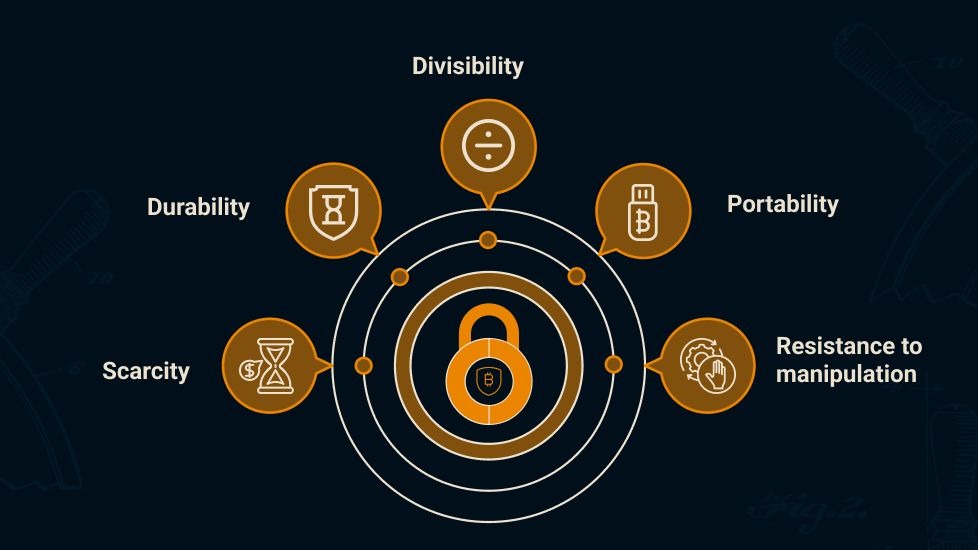
Bitcoin was created to enable peer-to-peer payments without banks. In doing so, it introduced a new form of money that is scarce, resistant to manipulation, and capable of storing value, which meets the criteria of sound money.
Scarcity
Only 21 million BTC will ever exist. This cap is hardcoded into the protocol and can't be changed without consensus from the entire network. New coins enter circulation through mining at a known, transparent rate that halves roughly every four years during Bitcoin's halving events. This gives BTC a level of scarcity that rivals and arguably exceeds gold.
Durability
Bitcoin runs on a decentralized network with no single point of failure. Thousands of independent nodes maintain the ledger. As long as the network and the internet continue to operate, Bitcoin remains accessible and can’t be destroyed or seized, unlike gold.
Divisibility
Each BTC can be divided into 100 million smaller units called satoshis. This divisibility makes it practical for transactions of any size.
Portability
Bitcoin can be transferred anywhere globally within minutes without third-party involvement. You can also take your bitcoin (or rather the private keys to them) with you wherever you go in your own personal wallet. This makes it far more portable than gold.
Resistance to manipulation
No central authority controls Bitcoin's supply. No government can print more, no central bank can adjust its issuance. This is what separates it from fiat currencies and the inflationary pressures they carry.
Money Worth Holding
Sound money has enabled long-term economic planning and protected savings for centuries. The gold standard fulfilled this role despite its limitations until the shift to fiat removed the constraints that once kept monetary expansion in check. Fiat attempted to fill the gap but has failed as a reliable store of value.
Bitcoin restores what was lost through decentralized issuance, fixed supply, and global accessibility, carrying the key characteristics historically linked to sound money. But holding BTC on an exchange doesn’t give you these benefits. For that, you need to master self-custody.
The Bitcoin Way offers personalized consulting services for Bitcoiners looking to self-custody their holdings and fully benefit from bitcoin’s sound money properties.
Start your path to financial sovereignty by booking a free 30-minute consultation with our experts.

FAQ
What are the properties of sound money?
Sound money is divisible, durable, portable, scarce, and resistant to manipulation. These properties ensure it can function as a medium of exchange, be transferred easily, and hold its value over time.
Why is gold considered sound money?
Gold is considered sound money because it is durable, scarce, and widely accepted. Its physical nature makes it divisible, allowing it to operate both as a medium of exchange and a store of value. For centuries, these properties have allowed it to serve as the basis of the global monetary system.
Is fiat currency sound money?
Fiat currency isn’t considered sound money. Fiat supply has no hard limit, which allows governments and central banks to expand it through monetary policy. The result is inflation and a gradual loss of purchasing power.
Is bitcoin sound money?
Many supporters argue it is. Bitcoin has a fixed supply of 21 million, is divisible, portable, durable, and resistant to manipulation. These properties make it resistant to both censorship and inflation, unlike fiat currencies.