
The Fight for Privacy - #PardonSamourai
In this article:
It hasn’t been a great week for the Bitcoin community, and not just because of the recent price action.
On December 19th, the Samourai Wallet developer Keonne Rodriguez was sent to federal prison for conspiracy to operate an unlicensed money transmission business. The pair were sentenced to five years behind bars, with an additional three years of unsupervised release, along with a $250,000 fine.
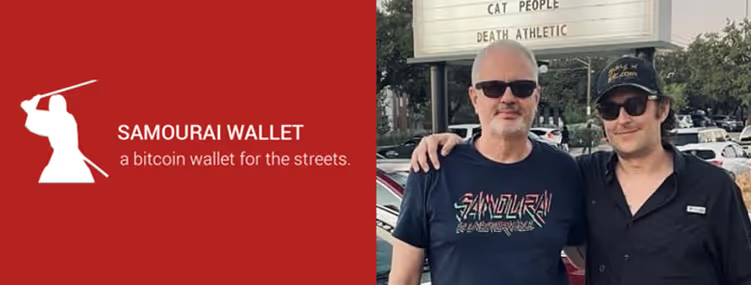
This disappointing verdict represents a direct attack on Bitcoiners everywhere. Keonne and Bill weren’t locked up for facilitating crime, they were jailed for writing open-source software designed to protect your financial privacy.
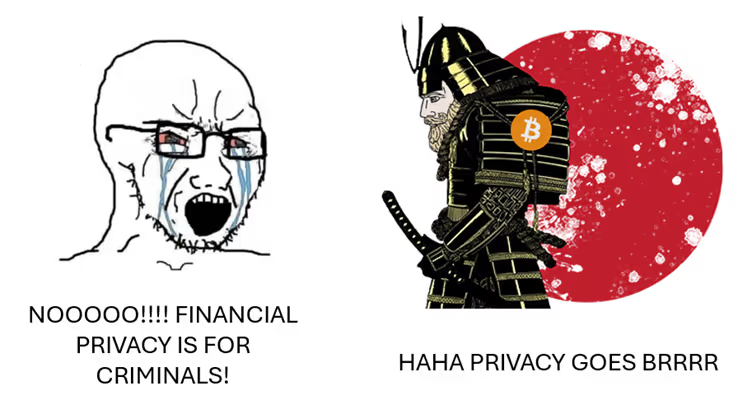
In the eyes of the government, this isn’t acceptable. Allowing you to use Bitcoin privately threatens their ability to monitor, control, and steal from you via taxation. If Samourai’s privacy tools were allowed to gain widespread adoption, it would cause real problems for the authorities.
The Samourai case had nothing to do with protecting the public, it was always about protecting the interests of the state.
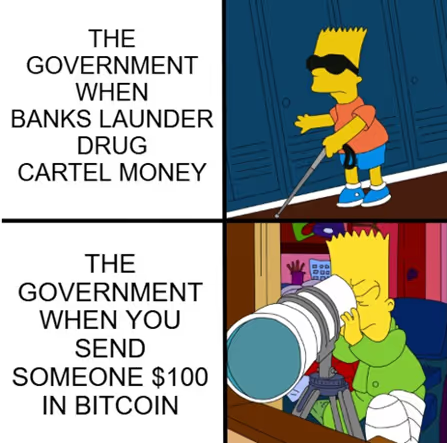
By punishing Bill and Keonne, the government is sending a very clear message. They don’t want us transacting privately, and they will punish anyone who attempts it. We need to send a very clear message back. Privacy is NOT a crime, and we stand with the Samourai developers.
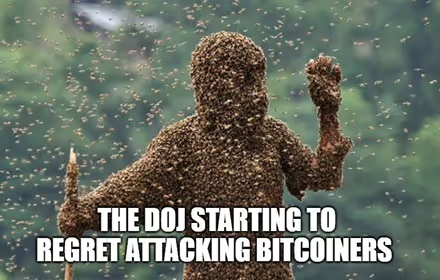
This week, let’s explore the details of the Samourai case, how it impacts all of us, and what we can do to fight back and secure Keonne and Bill’s release. It’s time to show the Department of Justice (DOJ) what happens when you kick the hornet’s nest.
Bill & Keonne: The Back Story
Bill and Keonne first met in 2012 when working at Blockchain.com and developed a close relationship through a shared passion for separating money and state, and their belief in Bitcoin’s potential.
Over time, however, the pair became disillusioned with the industry’s increasing focus on scaling solutions and institutional adoption, at the expense of financial privacy. Keonne and Bill understood that censorship resistance and privacy are not mutually exclusive. The state doesn’t have the ability to censor Bitcoin transactions at the protocol level, but if your transactions aren’t private, then they can punish you retroactively for making transactions they don’t approve of.
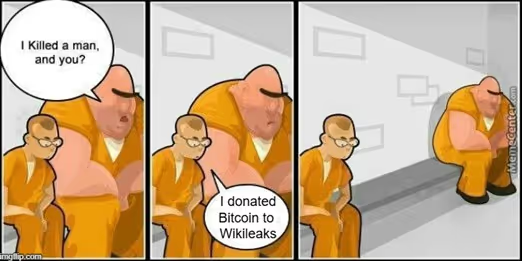
You won’t be sending many censorship-resistant transactions from jail...
In response to this problem, Bill and Keonne set to work on a solution and began developing a new Bitcoin wallet designed specifically to address the privacy concerns associated with transacting on Bitcoin’s public blockchain.
Rather than just complain about Bitcoin’s lack of privacy or move on to other projects, Bill and Keonne did what all great cypherpunks do, they wrote code. And in 2015, Samourai Wallet was born.
A feature-rich Bitcoin wallet built with privacy in mind.
A Bitcoin wallet for the streets.

A Bitcoin Wallet for the Streets
The Samourai devs built, without question, one of the most innovative and feature-rich Bitcoin wallets available. If you took the time to learn how to use it, then Samourai Wallet could transform you into a privacy-preserving Bitcoin power user.
A lot of the features Samourai offered you still can’t be found in even the best Bitcoin wallets available today:
Ricochet: A feature that adds multiple “hops” to your transactions by routing them through several user-controlled intermediate addresses before reaching the intended destination, obscuring the direct link between sender and receiver to confuse chain analysis tools.
PayNyms: Based on BIP47, PayNyms let users generate reusable payment codes that enable repeated private payments to the same party without reusing addresses.
Stonewall: A post-mix spending tool that simulates a CoinJoin transaction structure, even when spending alone, making it harder to cluster UTXOs and link them to one single entity.
Stowaway: A collaborative PayJoin tool that allows two parties to create a joint transaction that hides the true payment amount and breaks common input ownership heuristics, which results in enhanced privacy for both parties.
Stealth Mode: A feature that allows you to hide the Samourai app icon from your device’s home screen to give you device-level privacy against casual inspections or theft.
With Samourai Wallet, you could even send encrypted SMS commands to a lost or stolen device to retrieve seed phrases, transfer funds, or wipe the wallet.
Ask yourself how many of those features you might find useful today, and how many your current favorite wallet offers. The Samourai Wallet devs were some of the most prolific innovators in the space.
Samourai’s Whirlpool
Of all the privacy features that Samourai created, by far the most controversial, and most popular, was their Whirlpool service. Incidentally, it was also the feature that would end up getting them in trouble with law enforcement.

Samourai’s Whirlpool is a zero-link CoinJoin implementation that allows you to “mix” your Bitcoin UTXOs with the UTXOs of other users. It gives you forward-looking privacy by breaking the deterministic links between your inputs, like the withdrawal from a KYC exchange, and new outputs which become indistinguishable from the ones owned by the users you mixed with.
For an imperfect but simple analogy, imagine you and ten friends each throw a $10 bill into a hat before shaking it up and then each pulling one out again. Nobody can tell which $10 bill originally belonged to whom, because they all got mixed. There is no link between your original $10 and the $10 you’re holding now.

The most important thing to understand about Samourai’s Whirlpool software is that it was completely non-custodial. Yes, Samourai developed the “hat,” but they could never control or access any of the Bitcoin that went inside it. Users always remained in full control of both their private keys and their funds.
Samourai never operated as a centralized money service business (MSB), and they never touched anyone’s Bitcoin. Whirlpool was simply a coordinator service that allowed users to collaboratively create a single transaction to combine their inputs and then redistribute their Bitcoin in equally sized outputs.
Samourai were open-source software developers, not financial custodians.

Samourai’s Notoriety
Samourai Wallet caused a lot of controversy. By allowing Bitcoin users to protect their privacy, their software made it very difficult for regulators and law enforcement to monitor people’s financial activity.
As you might expect, this is deeply unpopular with a lot of powerful interests. Bankers, politicians, law enforcement, and tax authorities all want to know how much money you have and exactly what you’re using it for.
The Samourai devs were definitely poking the bear...

Nevertheless, privacy is NOT a crime, and neither is writing non-custodial software that enables it.
In 2013, FinCEN, the primary regulator in charge of money transmission and illicit finance, put out clear guidelines stating that to be classified as an MSB or money transmitter, you need to take custody of your customers’ funds.
This makes perfect sense. How can you “transmit” something you’re never in control of?
FinCEN even updated their guidance in 2019 to explicitly state that anonymity service providers like tumblers or mixers that don’t take custody of customer funds cannot be classified as a money service or money transmission business.
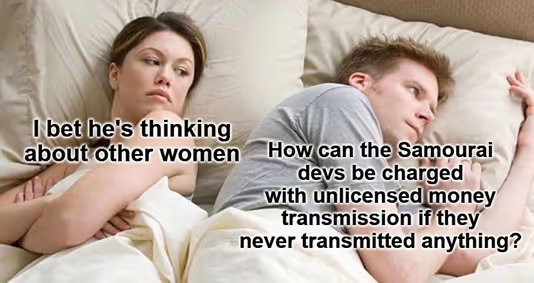
The Samourai developers, along with their legal team, examined the law closely and were confident they were not breaking any rules. Samourai was not a money transmitter and had no obligation to comply with any AML or KYC rules. They were simply software providers.
Could criminals use Samourai’s Whirlpool to cover their tracks and evade the authorities? Sure. But criminals make use of all sorts of everyday tools to commit their crimes. Holding software developers responsible for the actions of their end users would be like holding the Ford Motor Company responsible when a transit van is used in a burglary.

If criminals were ever to use Samourai’s software to launder money or transmit the proceeds of crime, then the Samourai developers would have no knowledge of it, no involvement in it, and no way of preventing it.
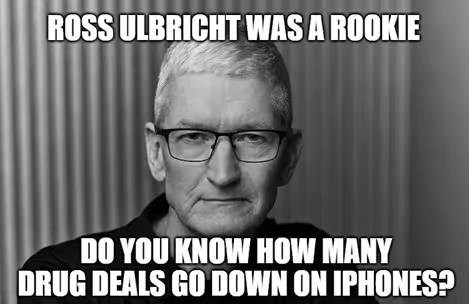
The Samourai devs not being able to prevent criminals from using their software should be no more controversial than Apple not being able to stop drug dealers using iPhones.
Samourai’s Arrest & Indictment
Having launched in 2015, the Samourai developers operated their software openly for almost ten years, confident they were on the right side of the law.
Unfortunately, in the battle to separate money and state, the state inevitably started fighting back, and Bill and Keonne were about to learn the hard way that the state doesn’t fight fair.

In April 2024, fifty armed FBI agents performed a dramatic raid on Keonne Rodriguez’s house in Pennsylvania, while William Hill was picked up by local authorities in Portugal.
The Samourai website was seized, and both men were taken into custody and charged with two federal offenses. One count of conspiracy to commit money laundering, and one count of conspiracy to operate an unlicensed money transmitting business.
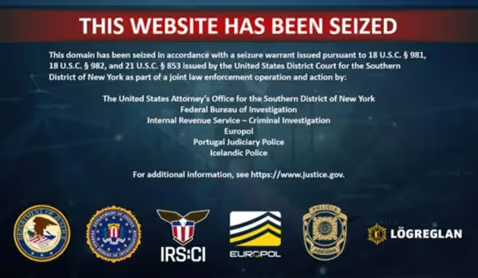
Rodriguez pleaded not guilty and was placed under house arrest as part of his $1 million bail conditions. Meanwhile, Hill was allowed to return to Portugal on a $3 million bond with conditions including GPS monitoring, pretrial supervision, travel restrictions, and requirements to appear in New York to attend court dates.
The Samourai Plea Deal
The Samourai developers both originally pleaded not guilty to the charges of unlicensed money transmission and conspiracy to commit money laundering. They were confident that because their service was non-custodial, it was clear they neither transmitted people’s money nor directly facilitated or participated in any money laundering activity.
So, with such a strong case, why did these innocent men end up accepting a plea deal and plead guilty to unlicensed money transmission?

The answer is simple. During pretrial discovery, the Samourai devs and their legal team would discover they had no chance of receiving a fair trial. They were up against a weaponized Department of Justice that was determined to get a certain outcome regardless of the truth or the letter of the law.
There were red flags everywhere.

One year into discovery, Samourai’s lawyers wrote to the prosecution to ask if they had ever had discussions with FinCEN about Samourai Wallet and were surprised to learn that they had.
It transpires that six months before indicting the Samourai devs, the government asked FinCEN if they thought Samourai were acting as an unlicensed money transmitter, to which FinCEN replied, “No, because they don’t take custody.”
The craziest part? The government withheld these communications from the defense for a whole year until they were directly questioned about it, despite being obligated to share ALL evidence they held against Samourai.

By suppressing evidence favorable to Samourai’s defense and material to the outcome of the case, the prosecution had violated Samourai’s due process rights in what is known as a Brady violation (Brady v. Maryland, 1963).
This revelation led Samourai’s legal team to file two motions. One motion to highlight the Brady violation and request an explanation as to why it was withheld, by whom, and if there was any other evidence being withheld. And a second motion to dismiss the indictment entirely, because even if all the prosecution’s evidence is true, Samourai had clearly not broken the law, as confirmed by FinCEN themselves.

Unfortunately, instead of getting better, things got worse. In an unusual turn of events, the judge assigned to the Samourai case was abruptly changed. The original judge, Richard M. Berman, was removed from the case, and it was reassigned to Denise L. Cote, a judge with a reputation for issuing maximum sentences.
This reassignment took place just days before the defense was due to plead their motions to dismiss. Following it, the defense was duly informed that the new judge had read their motions and had simply denied them without any written or oral explanation as to why.
It was becoming abundantly clear to the defense that Bill and Keonne were not being subjected to a fair process.
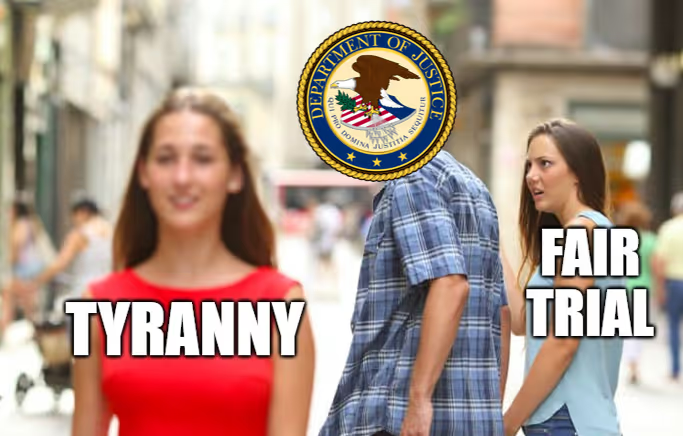
At this point in proceedings, it becomes clear why the Samourai devs would accept a plea deal. They were charged on two counts, one of conspiracy to operate an unlicensed money transmission business, which carries a maximum sentence of five years, and one count of conspiracy to commit money laundering, which carries a maximum sentence of twenty years.
The deal they were offered was to plead guilty to unlicensed money transmission, and the more serious charge, conspiracy to commit money laundering, would be dropped. Yes, they could have continued to try and fight the case, but after seeing the already shocking behavior of a clearly biased DOJ, would you really risk an extra twenty years behind bars?
Unfortunately, the defense had reached a point where the smartest move was for innocent men to plead guilty.
Not only was the prosecution’s behavior highly questionable, but their evidence was also hilariously flimsy. They could only accuse Samourai of “conspiracy” to commit crimes, because there was no direct evidence of any actual crimes being committed. They accused them of conspiracy to launder money, but could not point to any evidence of Keonne or Bill conspiring with anyone to do so.
The prosecution’s entire case relied on out-of-context and innocuous WhatsApp conversations with friends and satirical social media posts, which were a masterclass in marketing that apparently went over their heads...
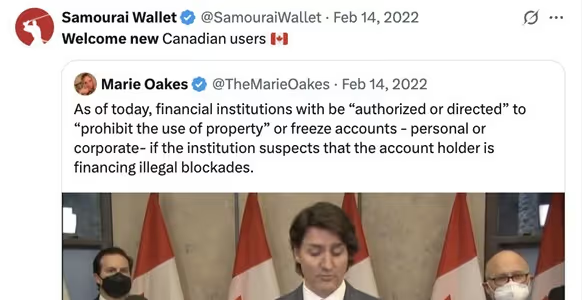
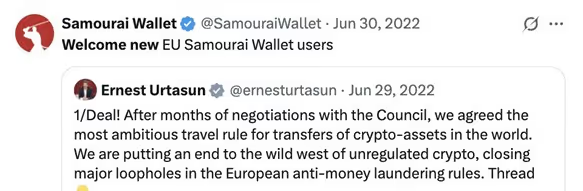
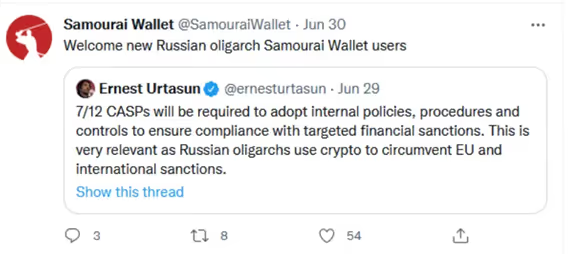
(They conveniently focused on the “Russian oligarch” tweet at the expense of the others because it was the only one that supported their narrative.)
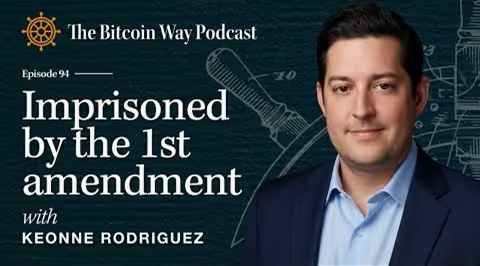
It would take a long time to trawl through every ridiculous detail of the case, but if you’re interested to learn more, Keonne himself articulates the story brilliantly in our recent podcast with him:
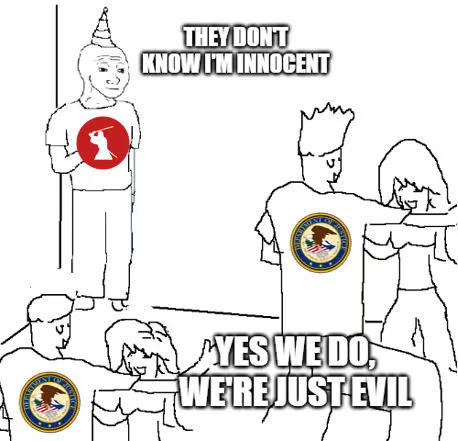
Ultimately, the whole case was a complete sham, perpetrated by people who either genuinely don’t understand the technology or who do understand it and are actively trying to falsely prosecute innocent men.
The more I hear about the case and the DOJ, the more I tend to lean toward the latter.
Samourai Devs Jailed: The Implications
The implications of this savage injustice are far-reaching and impact all of us.
Privacy tools are something we sorely need if we want to enjoy true censorship resistance. Unfortunately, the Samourai case will strike fear into the minds of any Bitcoin developer considering building them. The state can’t stop anyone from building FOSS privacy tools on Bitcoin, but by jailing Bill and Keonne, they can certainly make a lot of people think twice.
While fiat-minded influencers are busy cheering on treasury companies, Wall Street, and paper IOUs, the true innovators, the ones actually making a difference, are being locked up.
It’s a sad state of affairs.

The DOJ’s behavior is a direct attack on our fundamental freedoms. Privacy is not a crime, and normalizing KYC’d and traceable Bitcoin puts users at direct risk of data breaches, hacks, and even physical theft.
We must refuse to accept the idea that financial privacy is something that should be prohibited and recognize that the DOJ isn’t interested in protecting U.S. citizens, its primary function is to maintain state control.
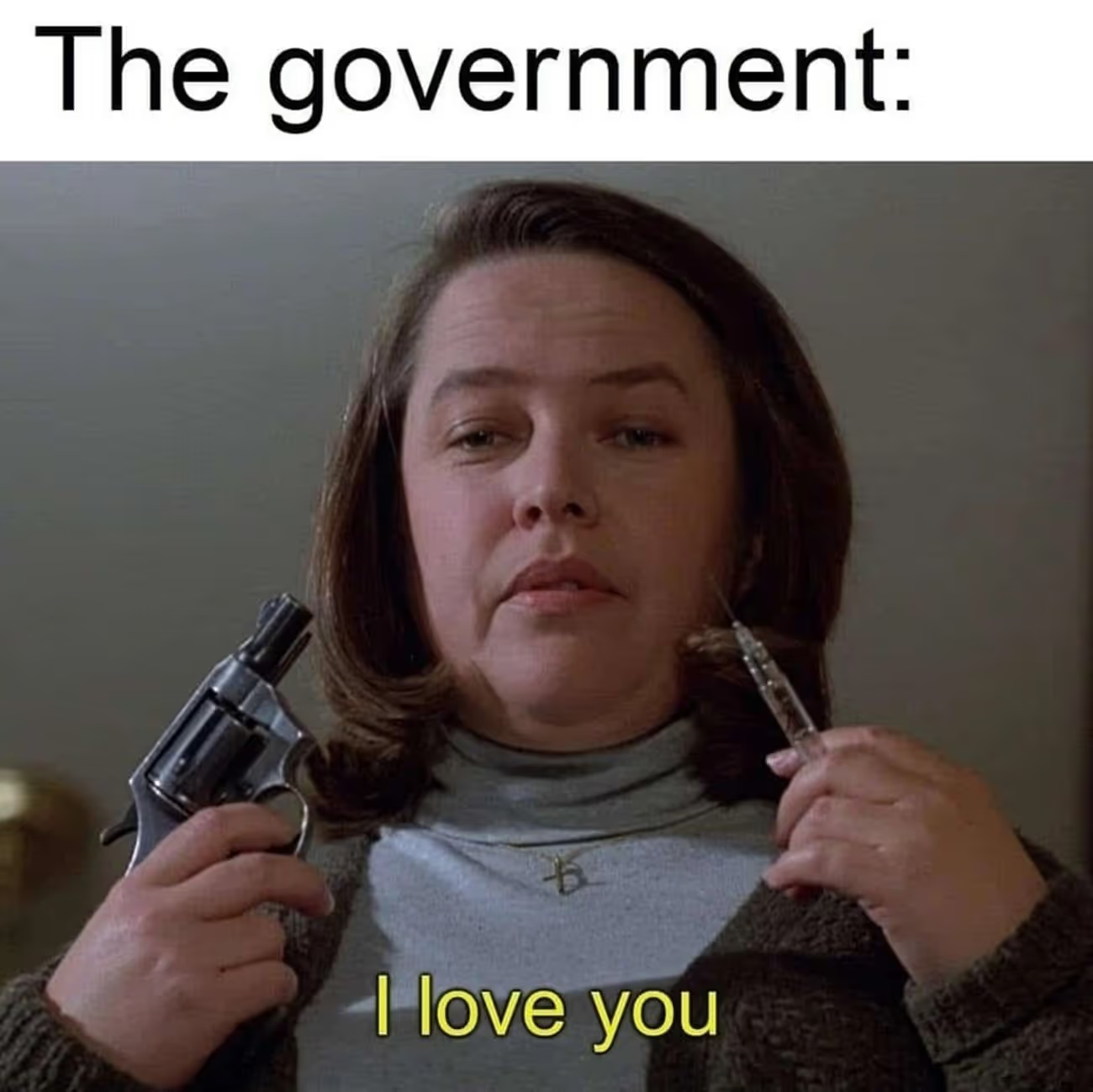
Tragically, there are also very real and immediate implications of this ruling that directly affect the lives of two innocent men and their families. Bill and Keonne have been stripped of their freedom and torn away from their loved ones despite not breaking any laws. They face a cruel five years away from home and have been left with a mountain of debt due to the cost of trying to defend themselves.
Take a second to think back to the person you were five years ago. How much have you changed since then? How much have those around you changed? How many happy memories did you create? How would you feel if you had lost those moments?
The DOJ is robbing these men and their families of something far more scarce and precious than just their Bitcoin.

We hope you’ll join all of us here at The Bitcoin Way in praying for their early release.
Join the Fight
This story is a sobering reminder of what we’re up against in our fight to reclaim our fundamental freedoms and regain our dignity. The state is a powerful and unforgiving adversary.
Against such overwhelming odds, our only hope is to stick together. That’s why we need you to join the fight and help us campaign for Samourai’s early release.

A presidential pardon from Donald Trump could see these men released and set an important precedent for financial privacy. It’s a fight we have to win.
Donald Trump is no fan of the DOJ and, in a recent press conference, has already mentioned he will look into the Samourai case. He also won’t be happy to learn that the rogue SDNY has already sold the Bitcoin they confiscated from Samourai despite his executive order stating it should be added to the nation’s strategic reserve.
As a community, we managed to convince Trump to pardon Ross Ulbricht. It’s time to do the same for Bill and Keonne. We do have a fighting chance.
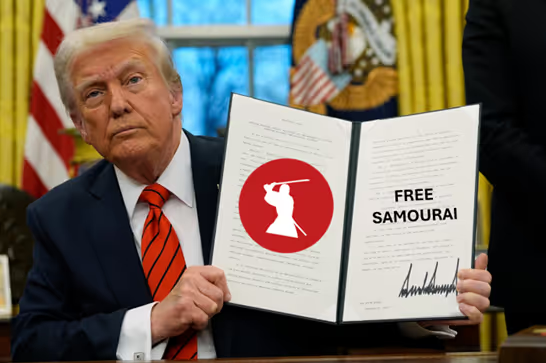
Here’s how you can help:
1) Sign the Change.org petition:
https://billandkeonne.org/
Ross Ulbricht credits a large part of his pardon to the number of signatures on his Change.org petition. The more signatures, the better. Sign it and share it with your friends.
2) Donate to support Bill and Keonne’s family:
https://www.givesendgo.com/billandkeonne
The case has decimated the Samourai devs’ finances. If you can, please help support their families in their absence.
3) Follow Keonne and Lauren
Follow Keonne and his wife, Lauren, on Twitter. Lauren will be relaying messages from Keonne on his account and will be sharing updates from her own. She would greatly appreciate any support.
4) Share Samourai content
The best way to get a presidential pardon is to make a lot of noise about this injustice. Help put this on Trump’s radar by interacting with any content that supports the cause. Share, like, and comment on anything with the hashtags #FreeSamourai or #PardonSamourai.
The DOJ may have won this battle, but we must remain resolute that we are going to win the war. If the Bitcoin community is great at anything, it’s helping others get back on their feet when the chips are down. Let us continue that tradition.
Thank you for your support.
#WeAreAllSamourai