
carf-the-latest-threat-to-your-bitcoin-privacy

In this article:
While you were busy celebrating the New Year, our Orwellian overlords quietly enacted dangerous legislation that will erode your financial privacy, track your behavior, and make taxing your Bitcoin as easy as possible.
It shouldn’t come as a surprise. Those Somali daycare centers aren’t going to pay for themselves…

On January 1st, the Crypto-Asset Reporting Framework (CARF) came into effect across the EU.
It requires all Crypto Asset Service Providers (CASPs), like exchanges and custodians, to provide annual reports to local tax authorities with details of their users’ personal information and crypto transactions.
These local tax authorities can then freely share this information with other international agencies in efforts to crack down on tax evasion.
Have you noticed the pattern yet?
The powers that be desperately don’t want you to have any financial privacy. It’s already bad enough that Bitcoin prevents them from controlling the money supply and censoring your transactions, but losing oversight of how much money you have as well?
Unthinkable!
The state doesn’t create wealth; it only survives by extracting it. Not knowing where the wealth is, or who’s holding it, presents them with an existential crisis.

That’s why, after having reluctantly accepted there’s no way to stop Bitcoin at the protocol level, the state is now pivoting toward mass surveillance and preventing you from using it privately. If the state can’t steal your wealth via inflation, it will be forced to use other means, and that process begins with figuring out who owns what.
Like burglars scoping out which is the best house to break into, the Crypto-Asset Reporting Framework is the government’s way of sizing up which Bitcoin holders are worth targeting for a shake down.
So this week let’s take a closer look at the Crypto Asset Reporting Framework to understand what it is, how it works, and how best to protect yourself from the prying eyes of Big Brother.
What is the Crypto Asset Reporting Framework?
The Crypto Asset Reporting Framework (CARF) was crafted by the Organisation for Economic Co-operation and Development (OECD) to create a set of standardised global rules designed to help tax authorities track crypto-related income and assets.
CARF requires Crypto Asset Service Providers (CASPs) to file annual reports on their user’s holdings, transactions, and personal information. Which means any exchange, third party custodian, or custodial wallet provider you use, will be obligated to surrender your data to the government.

As of late 2025, 75 jurisdictions have committed to CARF including the United States, European Union members like Germany and France, the United Kingdom, Australia, Japan, South Korea, Singapore, Hong Kong, Switzerland, and emerging markets such as Brazil, India, and South Africa. Even offshore centres like the Cayman Islands and Bermuda have signed up.
In 2026 CARF is only rolling out across Europe, and information sharing across jurisdictions won’t start until 2027. But it won’t be long before CARF starts being enacted across the globe.
By 2030 most of the modern world will be signed up, and every interaction you have with a ‘trusted’ third-party will be monitored, recorded, and shared.

CARF – The Implications
The OECD would have you believe that the Crypto Asset Reporting Framework is about fairness, accountability, and bringing criminals to justice. But nothing could be further from the truth. These people aren’t interested in fairness; they’re interested in control.
You’ll notice that the OECD shows no concern about central banks openly counterfeiting trillions of dollars every year, and that they don’t apply the same reporting requirements on the offshore trusts and art markets their wealthy friends use to hide their money.
It’s rules for thee, but not for me…

It would be tempting to write a diatribe questioning why the Government needs to tax your wealth at all, given they can create money from thin air. But we’ll save a long examination of why taxation is theft for another time.
For now, the most pressing concern with CARF is that it introduces serious and unnecessary risk to any Bitcoiner who interacts with a centralized third party.
The state having access to your data is bad news, because it has a very poor track record of keeping it secure. When you start looking up breaches associated with government agencies and tax authorities, you quickly come to realise that any data the state has about you will, at some point, end up in the wrong hands.
In 2019, the National Revenue Agency in Bulgaria was infiltrated by hackers who stole the financial records of almost the entire population, in 2020 in the United States an IRS contractor stole the tax return information of 405,000 high-net-worth individuals, and in the UK in 2024, organized crime groups breached over 100,000 taxpayer accounts.
The point is, the state is incompetent and will eventually lose your data, and when that data contains information about your Bitcoin holdings, it starts exposing you to serious risks.

So far, Bitcoiners have only really had to worry about Bitcoin companies leaking their data. (You probably heard the news that the hardware wallet manufacturer Ledger leaked their customer data yet again this week).
But even these small-scale leaks have shown us that Bitcoiner’s personal information will be used to orchestrate theft, and in some cases, even physical attacks. Almost every Ledger customer now frequently receives scam phishing emails, and in places like Sweden, where crazy laws allow you to look up anybody’s address, some Ledger customers have been targeted in physical attacks!
Now take a minute to consider the second order effects of CARF. Do you really think the IRS is likely to keep your data any more secure?

The state is nothing more than a mafia style organization that over time has been able to credentialize itself. The new CARF rules they are implementing aren’t there to protect you, they’re there to make it easier to extort you.
They don’t care if the methods they use to extract their protection money end up putting you in harm's way. That’s your problem.
Reclaim Your Privacy – The Bitcoin Way
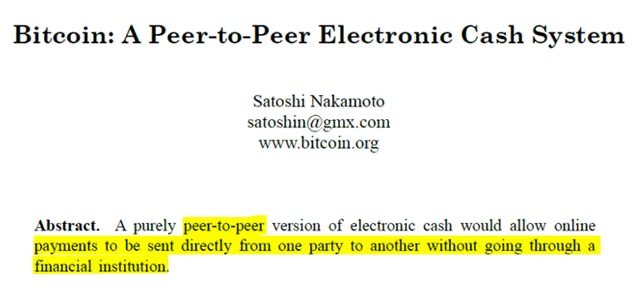
With CARF now being rolled out worldwide, you should make 2026 the year you leave KYC exchanges and custodians behind for good. Bitcoin is peer-to-peer technology, and you don’t need to do business with people who are willing to put you at risk for their own financial gain.
Instead, make it your mission to become truly sovereign, so that the next time a third-party institution asks you to provide them with a copy of your passport, you can kindly tell them to “GFY”.

It’s easier than you think to buy, custody, and even spend Bitcoin without ever having to surrender your personal information. You just need to learn the right tools and develop the right skills:
- Buy Bitcoin privately using peer-to-peer platforms.
- Take FULL self-custody so you never have to involve regulated third parties.
- Run your own node to broadcast and validate transactions.
- Practice careful UTXO management to avoid leaving breadcrumbs.
- Learn advanced tools like Coinjoins, Payjoins, and Silent Payments.
- Make use of the Lightning Network and sidechains to spend privately.
- Improve your overall cybersecurity and protect your online privacy.
If you’re serious about being truly self-sovereign, then these are the rabbit holes you should be exploring. With a little concerted effort, you can learn to use Bitcoin as peer-to-peer cash just as Satoshi intended, with no third parties and no compromises.
Are you ready to start taking your Bitcoin security and privacy more seriously? Just book a free 30-minute call with one of our experts and let’s get your training started today!